
Almost every roleplay community starts the same way. A handful of friends, an empty city, and a lot of optimism. Most never get past that stage. The ones that do tend to share a set of habits that have very little to do with advertising and a lot to do with what happens during an ordinary Tuesday evening.
Growth in this hobby is not really a marketing problem. It is a retention problem wearing a marketing costume.
The arithmetic nobody mentions
A server with eight regulars does not need a hundred new arrivals. It needs the next twenty visitors to stay instead of leaving after one session. That is a much smaller problem and a much more solvable one.
New players almost never explain why they left. They log in, wander for twenty minutes, and quietly never return. If you ask the few who do explain, the answers are depressingly consistent: nothing was happening, nobody talked to them, or the server did not run well enough to be worth the effort.
All three are fixable, and none of them require a bigger budget.
Something has to be happening when they arrive
The hardest moment for a small server is when a new person logs in at a quiet hour. They see an empty city, interpret it as a dead server, and leave. It becomes self-fulfilling.
The communities that break out of this tend to concentrate activity rather than spreading it thin. Instead of hoping people are online at random times, they establish two or three fixed weekly events. A Thursday night car meet. A Sunday race. A monthly auction. Regularity matters more than scale: six people who reliably show up at the same time every week will convince a visitor that the server is alive far more effectively than twenty people scattered across the day.
Events also give you something concrete to point at when you do advertise, which beats a generic description of your framework.
Vehicles are the easiest event fuel
Car culture generates recurring events almost by itself, which is why so many small servers build their early community around it. A meet needs no scripting, no staff supervision and no special systems. It needs somewhere to park and enough variety that showing up with your car means something.
That second part is where servers fail. If everyone drives the same three default models, there is nothing to show off and no reason to attend. The fix is breadth rather than exotic content: work vans, old sedans, pickups, a few tuners, and a small number of expensive machines that mark status. Starting from proper fivem car packs gives you that whole layer at once, built to a consistent standard so the streets look coherent and the performance stays predictable when everyone arrives at the same spot.
One badly optimised vehicle can cost more frames than twenty properly built ones, and the symptoms only appear during exactly the kind of crowded event you were hoping to run.
Motorcycles do a lot of work on small servers
This is underrated by most new owners. Bikes are cheap in almost every in-game economy, which means a brand new character can own something expressive within a day or two.
That timing matters enormously. The first week is when a player decides whether they are building someone or just visiting. Being able to afford a machine with real character early, rather than grinding for three weeks toward a car, dramatically increases the odds they stick around.
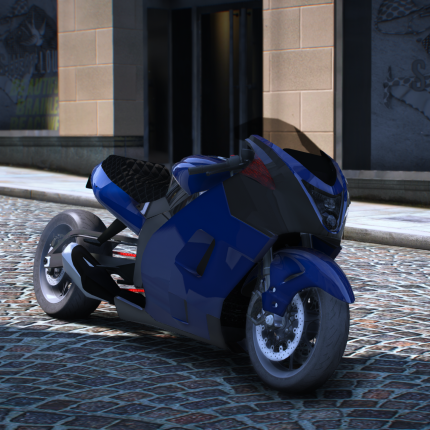
Motorcycle groups also form faster than any other organised roleplay. A few people riding together turns into a crew with a name, a hierarchy and a list of grievances within about a month, and that produces storylines that run all season. Servers that stock proper fivem mc choppers rather than a couple of generic bikes see this happen noticeably more often, because the aesthetic is most of the appeal. A convoy that looks like an event gets treated like one.
Somewhere to be beats something to do
Small servers tend to over-invest in systems and under-invest in places. The result is a city full of jobs and locked doors, where everyone ends up standing in the same parking lot because it is the only neutral space.
Interiors change this immediately. A garage gives mechanics actual customers. A bar gives the social players something to run. A clubhouse gives a crew somewhere to argue. These locations generate scenes without any scripting, and on a small server they also solve the visibility problem: when activity concentrates in a few known places, a new arrival can actually find people.
The server has to run well before anything else matters
It is worth stating bluntly because it undoes everything above. A visitor whose game stutters during their first real scene will not stay long enough to form any attachment.
Small servers often run on modest hardware, which makes discipline more important rather than less. Test every addition on a separate build before it goes live. Keep file sizes under control. Write down what was installed and when, so that when something breaks you have three suspects instead of three hundred. Remove content that causes crashes even if it was expensive.
Nobody ever compliments a server for running smoothly. They just keep playing.
Talk to the people who stayed
The most useful information you will get is not in a feedback form. It is the offhand comment that a district feels empty, or that a job takes too long to be worth doing, or that nobody goes to the north side of the map anymore.
A short monthly review of what actually got used, versus what you assumed would be used, is usually enough to keep the city moving in the right direction. It costs nothing and prevents the common trap of building features nobody asked for while the weekly complaint stays unfixed.
Growth is slow and that is normal
The servers that last did not explode. They added a few regulars a month, kept them, and built outward from a small reliable core. Two years later they look like overnight successes to anyone who was not watching.
What they spent money on, in order, was traffic, places and consistency, not systems and spectacle. For owners working through that list, Wmods covers most of the sourcing side with vehicles and interiors built to sit together, which leaves more of your attention for the part that actually drives growth: being there on an ordinary Tuesday when someone new logs in.