
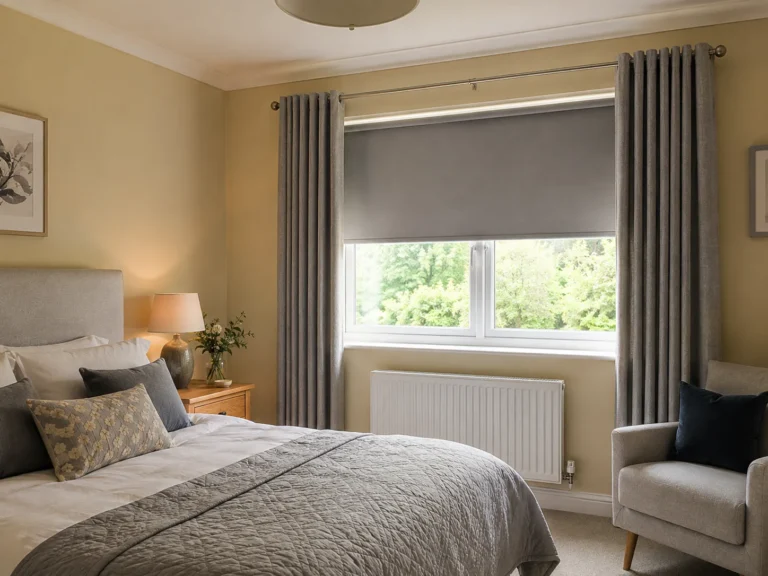
Large windows can be one of the strongest features in a room, but that does not mean the window treatment should become the strongest feature too.
Wide glazing, tall frames and generous expanses of glass already command attention through scale alone. Add a visually heavy blind, strong pattern or bulky arrangement and the window can begin to overpower the furniture, flooring and architecture around it.
The more considered approach is to treat large glazing as part of the interior composition. The blind should manage privacy and light while helping the window sit comfortably within the room, rather than making it feel even larger.
Start with the proportion of the whole wall
A large window should never be judged only by the size of the glass.
Look at the entire wall.
Consider how much space exists above and beside the window, whether the glazing sits centrally or off to one side, and what other architectural features share the elevation.
A wide window set within a broad wall may feel balanced naturally. The same window on a narrow wall can appear far more dominant.
This distinction matters because the blind becomes part of that overall geometry once it is closed.
For homeowners considering blinds brighouse for a room with substantial glazing, stepping back and assessing the full wall can be more useful than comparing materials at close range.
The aim is to keep the window visually integrated with the room rather than making the treatment extend its presence unnecessarily.
Avoid adding more visual weight than the glazing needs
Large windows already create a strong block within the room.
A blind in a very dark colour, dense pattern or visually heavy material can increase that weight dramatically.
That does not mean darker tones are unsuitable. In the right interior, they can look sophisticated and well balanced. The important question is whether the rest of the room can support them.
If the walls, furniture and flooring are relatively light, a very strong window treatment may become the focal point whether that was intended or not.
A quieter treatment often works better where the window itself is already the architectural feature.
Think about what happens when the blind is fully closed
This is particularly important with large windows because the closed blind becomes a substantial area of colour or texture.
A small fabric sample can be misleading.
A subtle weave may look almost plain at close range but create a strong textured surface across several square metres. A muted colour can feel much deeper once it covers the full width of the glazing.
Try to imagine the treatment as a complete plane rather than a small decorative detail.
If possible, compare samples from across the room. The view from the sofa, dining table or doorway is often more revealing than the view from directly beside the window.
Use colour to reduce competition
Where the aim is to stop a large window from dominating, colour can be used to soften the contrast between the glazing and the rest of the room.
A blind that relates closely to the wall colour can help the window feel more settled.
It does not need to match exactly.
A slightly warmer, cooler, lighter or darker version of the surrounding wall tone can create enough definition without turning the treatment into an isolated block.
This is especially effective in rooms where the architecture is already strong.
A pale stone blind on warm off-white walls, for example, may make a wide window feel integrated while still giving it enough presence to look intentional.
Let texture add interest instead of pattern
Large windows provide a lot of surface area, so even modest pattern can become visually powerful.
Texture is often an easier way to add character.
A softly woven surface, understated material variation or subtle tonal depth can make the treatment feel considered without covering the wall in a repeated motif.
This can work particularly well in rooms with:
- plain upholstery;
- timber flooring;
- neutral walls;
- simple cabinetry;
- or large areas of painted plaster.
Texture introduces enough visual variation to stop the blind feeling flat while keeping the scale of the room under control.
Large patterns need room to breathe
Pattern is not off limits, but it should be chosen with the actual scale of the glazing in mind.
A motif that appears restrained on a sample can become far more dramatic once repeated across a wide blind.
Large-scale pattern can work if the room itself is generous and the rest of the scheme is calm. Smaller-scale designs may be easier to absorb, particularly where the window already occupies much of the wall.
It helps to ask whether the blind should be part of the room’s decoration or simply support it.
If the sofa, rug, artwork or fireplace already provide enough visual interest, the window may be better used as a quieter backdrop.
Preserve the relationship with the view outside
One of the greatest advantages of large glazing is the view it provides.
A garden, terrace, mature tree or wider landscape can become a significant part of the interior during daylight hours.
A heavy window treatment that permanently reduces the visible glass can weaken that relationship.
Consider how the blind looks when open as carefully as when closed.
If a large amount of material remains gathered at the top or side, it may reduce the sense of openness that made the glazing attractive in the first place.
Someone comparing blinds denholme for a room where the view is important should think about how much of the opening remains visually clear during normal daytime use.
The best treatment often frames the view rather than competing with it.
Do not make every large opening equally prominent
Some rooms contain more than one large window or a combination of wide glazing and doors.
Treating every opening as a strong feature can make the room feel visually crowded.
Instead, decide which opening deserves the greatest emphasis.
A set of doors leading to the garden may naturally act as the focal point, while a side window can be quieter. Or a wide picture window may deserve more attention than adjacent glazing.
The blinds can reflect that hierarchy.
Related colours or materials can create continuity while different levels of visual emphasis help the room feel more composed.
Match the treatment to the furniture scale
Large windows often appear in larger rooms, but not always.
A wide window can dominate a modest room if the furniture is relatively small.
This is why the scale of the sofa, dining table, sideboard or bed should influence the window treatment.
If the furniture is visually substantial, the room may comfortably support a stronger blind. If the furniture is delicate or minimal, a very bold treatment may overwhelm it.
Look at the relationship between the biggest objects in the space.
The blind is effectively one of them once it is closed.
Use repetition elsewhere to make the blind feel intentional
If you choose a stronger colour or texture at the window, repeat it subtly elsewhere.
That repetition might appear in:
- cushions;
- artwork;
- a rug;
- dining chairs;
- ceramics;
- or a painted piece of furniture.
The colour does not need to appear in exactly the same shade.
A related tone is enough to give the eye a reason for the blind to belong in the room.
Without that relationship, a large window treatment can feel isolated simply because of its scale.
Consider how daylight changes the material
Large windows admit more light, which means they can also change the way colours and textures are perceived throughout the day.
A blind may appear pale and understated in strong daylight, then much richer once the sun moves away. Textured surfaces can become more noticeable under low-angle light, while certain colours can shift warmer or cooler depending on the orientation of the room.
Samples should therefore be viewed at several times.
Morning, midday, late afternoon and evening can reveal very different versions of the same material.
This is particularly important where the window receives direct sunlight for part of the day.
Evening use can make the blind feel much larger
After dark, the visual relationship between the room and window changes.
The view outside disappears and the blind becomes more prominent.
On a large window, that can transform the wall.
A treatment that felt almost invisible during the day may suddenly become a major block of colour behind the furniture.
For someone considering milnrow blinds for a living or dining space used mainly in the evening, it is worth judging samples under the room’s normal artificial lighting rather than relying on their daytime appearance.
A blind that works beautifully in daylight should still feel proportionate once the room is lit from within.
Align several blinds where the window is divided
Large glazing is often made up of several sections rather than one uninterrupted pane.
If separate blinds are used, alignment becomes especially important.
Headrails, lower edges and repeated divisions should look deliberate. Small inconsistencies can become more obvious simply because of the scale involved.
The architecture can help guide the layout.
Where mullions or frames repeat, aligning individual treatments with them can create a stronger sense of order than treating the window as one visually undivided surface.
This is one of those situations where careful measuring affects the appearance as much as the fit.
Keep everyday operation realistic
Large blinds can look elegant in photographs but still be inconvenient if the way they are used has not been considered.
Ask how often the blind will be moved.
If the window receives changing light throughout the day, frequent adjustment may be necessary. If the treatment is mainly for evening privacy, it may move only once or twice.
The control position should remain easy to reach without moving furniture.
Large sofas, dining tables and sideboards are often placed near substantial windows, so it is worth checking how the blind will actually be accessed.
A visually minimal treatment loses its appeal if operating it becomes awkward.
Make privacy proportionate to the actual need
Large windows can create a strong sense of exposure, particularly after dark.
The instinct may be to cover them fully and heavily.
But privacy should still be considered according to the actual sightlines outside.
A rear window overlooking a private garden may require very different treatment from glazing beside a pavement or facing neighbouring homes.
Understanding where visibility comes from can prevent the solution becoming heavier than necessary.
The goal is enough privacy to make the room comfortable, not necessarily maximum screening at every hour.
Let the architecture lead in modern rooms
Large windows are often an intentional architectural feature.
In contemporary extensions and renovated homes, wide glazing may be designed to create long sightlines, bring in daylight and connect interior and garden.
In those situations, the blind often works best when it respects the simplicity of the architecture.
That may mean:
- restrained colour;
- clean proportions;
- minimal visible bulk;
- consistent alignment;
- and an unobtrusive open position.
The blind should support the architecture rather than creating a second competing design statement across it.
Traditional rooms need balance too
Large windows are not limited to modern homes.
Tall sash windows, bays and generous period openings can also dominate a room if the treatment becomes too elaborate.
Here, a slightly richer texture or more decorative approach may suit the architecture, but proportion remains important.
Heavy detail at every edge can make a tall window feel even more imposing.
A considered balance between softness and restraint often works better than simply trying to make the treatment as grand as the opening.
The architecture already provides scale; the blind does not need to exaggerate it.
A practical checklist for large windows
Before making the final choice, consider:
- How much of the wall does the window occupy?
- Does the blind need to blend in or become a feature?
- What will the treatment look like when fully closed?
- Is the pattern too large once repeated across the whole opening?
- How much material remains visible when the blind is open?
- Does the colour relate to the surrounding walls and furniture?
- Is the outside view worth preserving?
- Are several blinds aligned with the window frames?
- Does evening lighting make the treatment feel heavier?
- Can the blind be operated easily around nearby furniture?
- How much privacy is genuinely required?
- Does the blind support the architecture rather than competing with it?
These questions usually reveal whether the window treatment is helping the room feel balanced or making the glazing more dominant.
Let the window be generous without becoming overwhelming
Large windows do not need to disappear, and they do not need to become the defining feature of every room either.
The most successful styling usually comes from respecting their scale. Use colour, texture and proportion to connect the treatment with the surrounding interior, keep the open position as visually clean as practical and consider how the blind changes the room after dark as well as during the day.
When the window treatment supports the architecture instead of competing with it, generous glazing can feel impressive without making the rest of the room seem secondary.
Frequently Asked QuestionsShould large windows always use plain blinds?
No. Pattern can work successfully on large glazing, but the scale and repetition need careful consideration. A design that looks subtle on a small sample may become much stronger across a wide window.
Are dark blinds too heavy for large windows?
Not necessarily. Dark treatments can look elegant where they relate to the walls, furniture and overall character of the room. The important issue is whether they create more visual weight than the rest of the space can comfortably balance.
How can I stop a large blind looking like a huge block of colour at night?
Choose a colour or texture that relates to other elements in the room, and view samples under the lighting normally used in the evening. Subtle texture can also add depth so that a large closed blind does not appear completely flat.
Should several sections of a large window use one blind or separate blinds?
That depends on the window design, dimensions, movement, access and the blind system being considered. Where separate treatments are used, careful alignment with the window frames can help the overall installation feel orderly.
What should I prioritise when choosing blinds for a large window?
Start with proportion. Consider how much wall the window occupies, how much of the blind remains visible when open, how the treatment relates to the furniture and whether the view and daylight should remain prominent. Those decisions usually matter more than choosing a particular style in isolation.