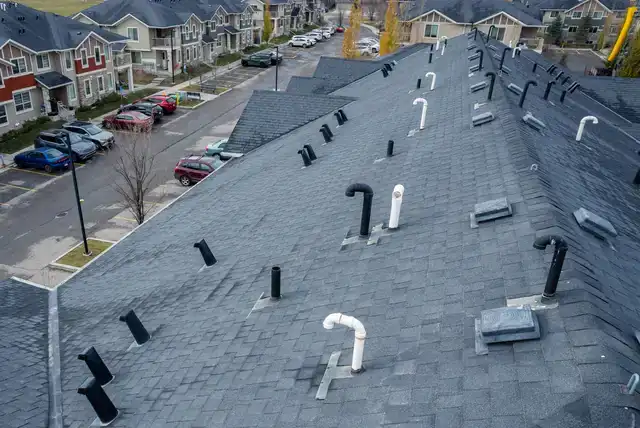
Drones have changed how commercial roofs get looked at. A pilot can launch from the parking lot and cover a large roof in the time it takes to find the ladder. The images are sharp, the roof does not get walked on, and there is nobody standing near a leading edge. For a facility manager with a long list of buildings, that is real value.
The risk is in the reading. A drone shows the surface of a roof, and most roof failures start underneath it. Understanding the gap between what the camera records and what the building is actually doing keeps the technology useful and keeps owners from making decisions on half the picture.
What a drone sees well
Overhead photography is excellent for anything visible from above. It finds standing water and shows how large the ponded area is and where it sits relative to the drains. It shows debris on the membrane, blocked drain strainers, leaves and gravel packed against a parapet, and rooftop equipment that has shifted or lost a panel.
It also gives a quick read on surface condition. Blistering, a broad crack pattern, exposed fastener heads, membrane that has pulled away from a curb, missing edge metal and torn flashing at a unit all show up from the air. A zoomed image of a corner after a wind event can save a crew a trip to the wrong side of the building.
The other benefit is the record. A dated set of images from the same flight path gives the owner a baseline, and comparing one season to the next shows change that a person on the roof might not notice.
What a drone cannot see
A camera cannot see through the membrane. Wet insulation looks the same as dry insulation from above until the water has done enough damage to deform the surface. Lap seams can look fine and still be failing, because adhesion is a matter of how well the weld or bond holds under load, and appearance says little about that. A sealed-looking seam with no bond is common after a few years of thermal movement.
Flashing is the other blind spot. The failure point is often behind a counterflashing or termination bar, in a spot where light does not reach and the camera angle is wrong. A person can lift a corner, press a seam with a probe and feel the difference between a bonded edge and a loose one. A drone cannot press on anything.
Finally, the drone sees a roof as it is at the moment of the flight. A seam that opens only when the temperature drops well below freezing will look perfect on a mild afternoon.
Where the camera misleads
Some images invite the wrong conclusion. Dark areas on a light membrane may be dirt, shadow, moisture or ordinary staining, and a photo alone does not tell you which. A gravel-surfaced roof hides almost everything. Snow, frost and low-angle November light all change what a lens shows. Late autumn mornings in Calgary can leave a membrane glazed with frost that looks like damage and is gone by noon.
The reverse also happens. An owner sees a clean set of photos and concludes the roof is fine. A clean surface is a good sign, but it is no clean bill of health. Treat drone images as evidence of surface condition only, and ask what has not been checked.
Where infrared and hands-on work fit in
Infrared imaging answers a different question. Wet insulation holds heat differently from dry insulation, and a thermal camera can show that pattern after sunset, when the roof releases the heat it absorbed during the day. That gives a map of where moisture is likely, which a technician then confirms with a core sample or a moisture probe. Some drones carry thermal sensors, but the survey is only as good as the conditions, the calibration and the person interpreting it.
When the real question is where water is getting in, a Calgary roof leak detection service combines the tools: a trained person traces the leak path, tests suspect details, and uses moisture and thermal readings to narrow the search. The drone is one input to that work, and the hands-on tracing finishes it.
A sensible inspection sequence
Used well, the tools stack in a logical order, from cheapest and broadest to most precise:
- A drone flight to document the roof, find obvious surface problems and plan the walk.
- A hands-on walk of the flagged areas, with probing of seams, flashing and terminations.
- Thermal or moisture scanning where there is any sign of trapped water or an interior leak.
- Core samples at the worst spots, to confirm what is under the membrane before a repair or replacement is scoped.
This sequence makes the drone earn its keep. It reduces time on the roof, focuses the expensive steps on the places that need them, and gives the owner a written record at each stage.
When a drone flight pays for itself
Some situations suit a drone almost perfectly. After a hail or Chinook wind event, a flight over a large roof shows within an hour whether edge metal has lifted, whether ballast or pavers have moved, and whether rooftop units took damage. That lets the owner decide quickly which buildings need a crew first and which can wait.
Drones also help with roofs that are hard or unsafe to walk: steep sections, fragile skylight areas, roofs with a wet surface, or sites where winter ice makes a ladder climb a bad idea. They are useful for pre-bid work too. A contractor who has current images of the roof can ask better questions, and the owner can share the same set with an insurer or a lender without sending anyone back up.
For a portfolio, a seasonal flight gives a consistent view of every building on a set schedule. Over a few years that record shows which roofs are changing and which are holding steady. The images do not replace a maintenance visit. They tell you where to send one.
Turning images into a repair list
A folder of photos is not a plan. The useful output is a marked-up roof plan with each finding numbered, a photo beside each number, and a short note on what it means and how urgent it is. Debris at a drain is a same-week job. A lifted edge metal section is a repair before the next windstorm. A faded membrane with no other sign of trouble is a note for the budget.
Ask for the findings ranked in that way. It lets a property manager hand the list straight to a contractor and compare quotes against the same scope.
Questions to ask before you hire a flight
Not every drone operator knows roofing, and not every roofer flies a drone. Ask who will review the images, and what that person knows about membranes, flashing details and insulation. Pretty images from someone who cannot read a roof are expensive wallpaper.
Ask what the report will say and what it will not. A trustworthy provider states plainly that a visual survey cannot confirm moisture in the assembly or the strength of a seam. Ask whether the deliverable includes annotated images tied to a roof plan, and whether the same flight path will be repeated next year. Ask about airspace rules near the building, insurance on the pilot, and how the operator handles tenants and neighbours who notice a drone overhead.
For insurance work, ask how the images will be used. A drone survey after hail or wind is useful documentation, but an adjuster will still want physical evidence, and a trained inspector’s findings carry weight that a photo set alone does not.
Use the drone as the first look, not the last word
A drone is a good way to see a roof quickly and safely, and an even better way to build a record over time. It will not find hidden water, test a seam or judge a flashing detail. Owners who understand that split get value from every flight and avoid the expensive surprise of a roof that looked fine in photos.
If you manage several buildings, build the sequence into your program: a flight each season, a hands-on visit where the images raise questions, and thermal work or cores when the evidence points to water inside. That mix costs less than waiting for the ceiling tile to stain.
About the author: this article was contributed by a HAAG-certified inspector at Superior Roofing in Calgary. The inspection team pairs aerial documentation with hands-on probing, thermal checks and core sampling when a commercial roof needs a clear answer about what is happening under the membrane.